From Robin Denney, Sudan:
Dear Friends,
I’m half-way through my first year in Sudan. So I thought I’d reflect some on the journey thus far. (my more traditional monthly reflection is posted on my blog, “God can revive us” June 1). This is technically my June update, I’m a bit behind schedule!
I have been blessed in my work to see a vast amount of southern Sudan. I have visited 19 of the 24 southern dioceses, and logged more than 150 hours on the wild pot-hole strewn dirt roads. It is a tremendously diverse landscape, from black rock mountains in Eastern Equitoria, to dense forests in Western Equitoria, to the tree scattered grassland of Lakes state, to the flat dry plains of Jonglei to the largest seasonal swamp in the world that stretches across several states. The wilderness of southern Sudan is vast. You can drive hours without seeing a single hut.
There are hundreds of people groups and languages in Sudan. There are tribes that are solely agriculturalists, and tribes that are solely livestock herders. There are villages placed on top of rocky mountains for security, villages along fertile rivers, and villages of huts spread far apart on the plain. I have seen the houses of the fabled three little pigs, made of grass, sticks, and bricks: grass walls where people fear attack so they can escape through the walls, houses of sticks in IDP camps with a roof made of a tarp, houses of bricks in villages that have security and prosperity.
It's hard for people in the developed world to imagine what life in a village of huts is like. Most people survive on subsistence agriculture or livestock herding, but there are always shop keepers as well. Living in a hut does not make someone impoverished. Many of the bishops here live in huts, because no other housing is available. It is the lack of schools and medical care which deeply affects people's quality of life. No matter how far out we have gone, even days of driving past nothing but wilderness and occasional villages of thatched huts, to the most rural areas, you still find the same influences from the outside world: coca cola, western clothing, cell phones, plastic bags, and guns.
Life in Juba is different. It is busy and there are traffic jams, lots of shops, buildings springing up everywhere, but it still has the feel of a country town, a country town with a million people. On my way to work I pass some nice air-conditioned shops, and shops in sheds, and a man who has a copy machine on a rickety table under a tree. There are piles of garbage along the streets, which slowly get cleared only to be replaced. Juba is spread out enough that people grow some food in the open spaces and yards. There are only two paved roads in juba, not more than 2 miles long, which are also the only paved roads in south Sudan. Everything that is sold is trucked in from Uganda, over the most impossible dirt tracts with potholes the size of elephants that fill with water, and rickety bridges, which means prices are highly inflated. Juba is one of the most expensive places to live in Africa. There are a couple Chinese and pizza restaurants, and even a large-scale brewery that just opened outside town, though drinking is discouraged among most Christian denominations. The city feels quite safe during the day, but it’s not a good idea to go walking after dark, which is 7pm year-round, this close to the equator. Most of the year it is hot, 90 degrees inside or outside, day or night, which means you get used to it. But this time of year cool spells come with the rain.
Conflict in south Sudan continues, though we don’t see it in Juba, we hear about fighting in the rural areas near by. Occasionally we hear of someone’s relatives, or church members who have been killed, or children abducted. The UN announced that the fighting in south Sudan is now more violent and deadly than what is going on in Darfur. Death from treatable diseases also continues to be high, with child and maternal mortality rates some of the highest in the world. Without peace there cannot be development. Pray for peace!
I am still loving my job. I am inspired by the bishops and pastors of the church, who work tirelessly without pay. I love giving workshops on sustainable agriculture. I love making connections between organizations working in agriculture, and dioceses who want to do agriculture projects. I love the process of developing the details of a plan for the ECS Agriculture Department, when the vision came from the bishops and the people. I love working in the demonstration garden I’ve started. I love the enthusiasm for agriculture I encounter at every turn. There are challenges too. Banking issues have prevented us from receiving donor funding for our department, so I am still the only staff member of the department, and we haven’t been able to start our larger scale production projects. I struggle to keep up with the daily tasks of the office, often falling behind, and getting overwhelmed. I struggle with loneliness from time to time, it is difficult to be so far away from family and friends, especially when there are people graduating (congrats Jordan and Colleen!) and having babies (welcome to the world Reese!).
Learning what life is like for other people in the world, realizing that more than half of the world’s population lives on $2 a day or less… this is important. It’s not about guilt. I don’t think that guilt helps. But I do know that Jesus leads us by his example, out into the world, into relationship with people who we think are different from us. Jesus broke the rules of society to cross the barriers his culture put up, to embrace the outcast and the suffering. Christ came not with wealth and power, but as a poor manual laborer who started life as a refugee. He radically challenged the established, the wealthy, the powerful, and the comfortable. He spoke strongly for justice peace and reconciliation.
When we open our eyes, and our hearts, we see that every last person on earth is the same, a beloved child of God. Fixing or changing people or the world is not our work. Our work is to be agents of reconciliation, love, peace, and hope in everything we do, in the way we live our lives! And it is a calling of great joy! I struggle with this as much as the next person. It’s good to remember that being the love of Christ to the next person who walks into my office, is probably more important then my project planning!
Peace,
Robin
--------
See my blog: http://robin-mission.blogspot.com
New this month: A joke! Reflections from another trip with the Archbishop, and a photo from my trip to Egypt, among other tidbits.
Want to know more about the Episcopal Church of Sudan? Check out their website: http://sudan.anglican.org . Also check out the Agriculture Assessment and visioning document I’m working on implementing for ECS at: http://sudan.anglican.org/files/090520agriculture.pdf
I’ve decided not to post my financial reports online, but I would be happy to email it to anyone who would like to see. I will also submit a full detailed report to each of my sponsoring churches at the end of the year, and email out a summary as well as post it online. So far my mission fund has paid me a stipend of $500 per month, covered my travel expenses around Sudan and to Kenya and Uganda (mission related trips and one R&R trip). And it has covered small needs as they arise like tools, seed, transportation of other people, vehicle maintenance, etc. A big thank you to everyone who has contributed!!
Thursday, July 9, 2009
Update: Mid-Year Reflections from Robin Denney


Saturday, July 4, 2009
Help Needed With Birth Expenses
From the Rev. Jerry Drino, Hope With Sudan:
Ajout, wife of James Majok Deng is about to give birth to their first child. She lives in Australia and he in San Jose. While she visited last year for four months they tried desperately to get immigration papers for her because he is a U.S. citizen but they did not succeed. James is finishing at East Bay State University (Hayward) and only has a part-time job because his other job was terminated. Ajout and James would appreciate any support you might give to help with the medical expenses. Checks, which are tax deductible, can be made to Hope With Sudan, 5038 Hyland Ave, San Jose, CA 95127 or given to the Cathedral Office made out to Hope With Sudan.
Additionally, five of the Sudanese have been laid off because of the economy. Any knowing of a part-time or full-time job can call Fr. Jerry Drino (408) 259-2111 or email jdrino@hopewithsudan.org.
San Jose Sudanese Graduates
From the Rev. Jerry Drino, Hope With Sudan:
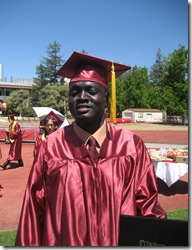
Gabriel Makuei Tor arrived as a refugee four and a half years ago from Kenya. He had watched as his friends left in 2001 for the US never thinking that he might never be called. In the meantime he followed his vocation to ministry by teaching English and leading Bible classes for over a hundred Sudanese widows in Nairobi. Then his day came to be relocated to San Jose. This last Saturday he graduated from De Anza College with plans to enter San Jose State University in the fall in pre-nursing. His ultimate goal is to be a priest. He is a gifted choir leader, hymn writer and poet. This is one of his poems that appears in the recent De Anza Journal, The Red Wheelbarrow:
Deep Down Beneath
Gone are the dead
Leaving with no pain
Leaving the pain behind
With remnants to bear
Missing nothing
But being missed
Deep down beneath the reach
Dead is dead
Not only dead
Dead has paid the debt
Under the world of no obligation
Wit no hand to give
In the dark, idle corner
The silent remains
Gone forever are the dead
Taking nothing more than wisdom
Were all ages and races meet
To live in peace then piece
Where sexes do not belong
Is where one lives again
Here,lay the dead.
Tuesday, June 9, 2009
Dean David Bird reflects on visit to Diocese of Gloucester
From the Very Rev. David Bird, Ph.D., Trinity Cathedral:
Dean’s Desk, June 2009 issue of The Carillon (reprinted with permission)
“Can anything good come out of Nazareth?” asked some of Jesus’ critics. “A prophet is not without honor except in his hometown and in his own household," said Jesus.
A strong current of tension runs through the gospel accounts of Jesus’ ministry and never more so than when he is at home. For such reasons I have often wondered whether it is indeed a good idea, as so many of us do, to go back home when we begin our ministry or whether we should start afresh somewhere else.
Faithful to tradition, however, I began my ordained ministry in the very diocese in which I had been confirmed as an adolescent. In a little under three years I was working in the United States, initially intending it to be a short term arrangement to learn particular skills before returning home.
Almost thirty-seven years later, this May, I returned to work in England for a week and found myself enthralled by comparing our religious cultures and understandings.
Undoubtedly we have much to learn from one another. There is a sense of permanence to the life of the Church of England that is beguiling and probably false. There is, by contrast, a sense of invention and creativity to the American church—and yet, in so many ways, we live in a much tighter liturgical straightjacket than some of the inventive parishes and ministries we were privileged to visit in the Diocese of Gloucester.
To see some of our English colleagues working in beleaguered housing estates (their equivalent of ‘projects’) was heart-warming. On a Saturday afternoon, we visited one church in which one of the groups meeting there was of the Baha’i faith and deeply concerned to see inter-faith cooperation in this troubling and financially troubled neighborhood. Their goal: to establish better community relations and encourage people to live by the Golden Rule (treat others as you would have them treat you). Here was potential for inter-faith witness and even worship.
On the surface, of course, we seem so much more progressive than the Church of England. The ordination of women to all orders of ministry is something we now take for granted. Here was a national Church still struggling towards the ordination of women as bishops. And yet the joy with which they welcomed our bishop was wonderful.
From us they could learn something about the fullness of ministry when it is truly representative of God’s people. In them we saw the church acting as a community of churches called to shared ministry with their bishop rather than a set of individual parish congregations—they were living out a vision we have committed to in this diocese.
Whenever we step out of our safe and customary environment, we are able to see possibilities in our own situation and even develop ideas we already accept but are still working towards.
We also saw reasons for the parallel but sometimes different paths of our respective journeys as members of the Anglican Communion. Our individualism as parish communities has some grounding in the particularly American experience of episcopacy. For the one hundred and sixty-nine years of the American colonies before 1776, we had to do without a resident bishop. The colonies were three thousand miles away for the Bishop of London (then our only bishop), most of which meant traveling by boat for a visitation. Doesn’t it make sense that in the American Church the bishop shares responsibility with a standing committee? The development of the standing committee was essential to the management of the church in our distinctive missionary situation and led to an expression of shared ministry which we model for much of Anglicanism.
Our distinctiveness comes home when we think of some of the great Episcopalian figures in US history— Washington, Jefferson, Franklin, Hamilton— and realize that together with so many of their contemporaries they had not been confirmed (then a requirement before taking communion) but were communicants of the church only through a special rule or canon which said that if you desired to be confirmed but could not be because of local circumstance you were permitted take communion. Is it any wonder that the USA adapted to the principle, enshrined in our 1979 prayer book, that baptism constitutes full membership of our church?
If I left Britain with one idea in mind it was that the companion relationship which we have with the Diocese of Gloucester, England and the Diocese of Western Tanganyika in Tanzania will locate in a fellowship of diverse church experiences which can lead to the Holy Spirit’s powerful witness among us. For that we surely thank God.
-David
Friday, June 5, 2009
World Mission Day Summaries
On May 16, a gathering of over 57 people met with Bishop Mary at St. Paul's in Salinas to hear the Bishop's report from her recent trips to our companion dioceses, Western Tanganyika and Gloucester. After her presentation, which included a slide show, commentary and a Q&A session, the participants broke out into groups to discuss and gather ideas around several initiatives supporting World Mission in the Diocese of El Camino Real.
The discussion groups were self-selected into the following subject areas each with their own discussion leader/facilitator: Solar Cooking, School Tuition, Pilgrimage, Micro-Credit Loans for Sewing Machines and Seminary Tuition & Hospitality.
There was lots of positive energy and enthusiasm in each of these groups. Summaries of their discussions and contact information for leaders/participants are available here.
Sunday, May 31, 2009
Easter in Bor Diocese
From Robin Denney, Sudan:

This Easter trip to Bor is actually a peace and reconciliation and evangelism trip, as well as the Archbishop’s official visit to the Diocese of Bor, and the new Diocese of East Twic, just instituted today, April 13! We are about 75 miles north of Bor, and will continue to travel the rest of the week up further, returning to Bor.
This is Jonglei State, which has suffered from a lot of deaths from cattle raiding --750 died last month, and another 40 were killed in one village on Palm Sunday. This trip was put together to talk about peace and reconciliation in the Christian context. Since 90% of the population here is Episcopalian, it has particular impact!
We are traveling with the Archbishop, his wife, Mama Deborah, three other bishops, about 30 assorted pastors and staff, and a marching, dancing choir of about 150. The choir travels in two big open trucks. There is a pickup with a generator and sound system for the rallies, so we make quite a convoy!
In other news, there was some trouble in Juba since we’ve been in Bor. No one was hurt, but a group of soldiers under one Commander in the southern army defected to join the northern army. This is a worrying development, as it shows some of the old dis-unity coming alive. The soldiers loaded onto a barge in Juba and headed north, apparently peacefully. Prayers for peace continue to be order!
I hope you all had a wonderful Holy Week and Easter,
Robin
Saturday, May 30, 2009
National Geographic, "The Forgotten Faithful"
From Rev. Michael W. Ridgway, St. Stephen’s-in-the-Field:
Followers of Jesus for nearly 2,000 years, native Christians today are disappearing from the land where their faith was born.
Read the article The Forgotten Faithful authored by Don Belt of National Geographic republished on the “Friends of Sabeel” website here.
And keep in mind that Naim Ateek, the head of Sabeel and author of the book: A Palestinian Cry for Reconciliation will be in the Bay Area July 24-26, preaching at Grace Cathedral at 11:00 a.m. on Sunday, July 26.


 Posts
Posts

